
Traditional vs Montessori: Which Method Is Better?
Parents often wonder whether to choose a traditional preschool or a Montessori program for their toddlers. Both approaches can support learning, but they differ in philosophy and practice.
How Traditional and Montessori Classrooms Differ
Feature
Montessori approach
Traditional approach
Role of the teacher
Guides and observes; prepares an environment that allows children to discover concepts on their own. Teachers intervene only when necessary and encourage independence.
Acts as a central authority figure; directs activities, leads group lessons and often corrects mistakes.
Learning pace
Children work at their own pace and choose activities that match their developmental readiness. Mixed‑age classrooms allow younger children to learn from older peers and older children to reinforce skills by helping others.
Activities are often scheduled, with the same lesson taught to an entire group of same‑age children regardless of individual readiness.
Materials
Designed with a control of error so children can self‑correct and learn through hands‑on exploration. Materials are self‑contained and build on one another.
Often worksheets or plastic toys that entertain. Mistakes are corrected by the teacher rather than discovered by the child.
Environment
Calm, orderly and beautiful; shelves display a limited number of materials at child height. Children choose their work and return it neatly when finished.
Typically more colorful and crowded. Toys may be stored out of reach, and group activities dominate the day.
Evidence in Favour of Montessori
Research suggests that Montessori education can offer significant benefits. A University of Virginia study found that Montessori programs help low‑income students keep pace with their higher‑income peers, supporting Dr. Maria Montessori’s belief that the method aligns with how children naturally learn. Long‑term studies have shown sustained benefits into adulthood, including enhanced executive function, better mathematical reasoning, stronger reading comprehension and improved social‑emotional regulation.
Montessori materials emphasise hands‑on manipulation that strengthens fine motor skills and build concentration and focus. Because each activity is self‑correcting and open‑ended, children gain confidence and intrinsic motivation. The American Academy of Pediatrics emphasises that play should promote problem‑solving, creativity and caregiver–child interactions, all hallmarks of the Montessori approach.
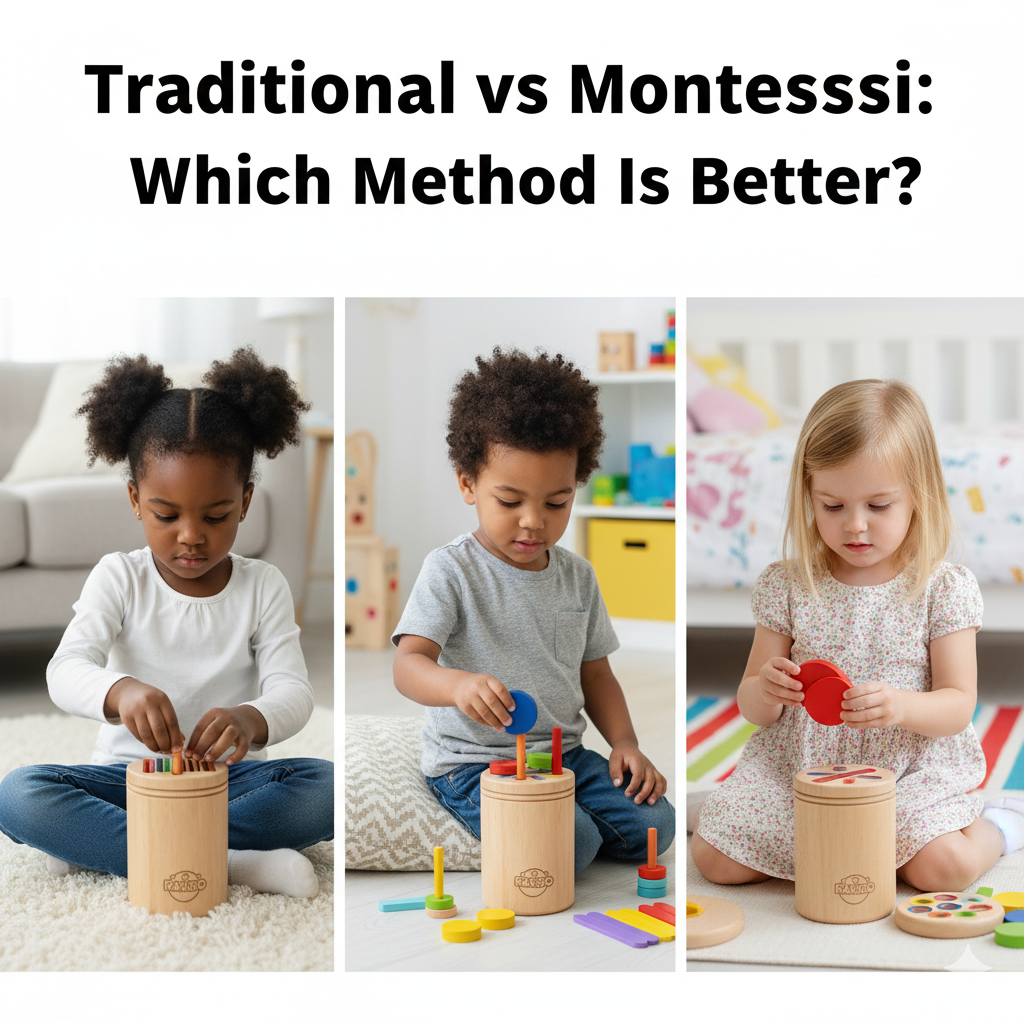
Traditional programs certainly prepare children for school and can be a good fit for families who value structure and direct instruction. However, if you’re drawn to a learning environment where your child leads the way, explores real‑life tasks and builds independence at an early age, Montessori may be the better choice. It’s not an either–or decision – many families blend elements of both approaches at home by choosing simple, non‑electronic toys and encouraging self‑directed play.
As parents and as a small, family‑run business, Rakibo believes that children thrive when they are given freedom within limits. Our color‑sorting toy invites toddlers to work at their own pace, develop concentration and feel the pride of accomplishment that comes from figuring something out without adult direction. Whether you enroll your child in a Montessori program or not, offering authentic Montessori‑inspired toys at home can give them a strong foundation for lifelong learning.
